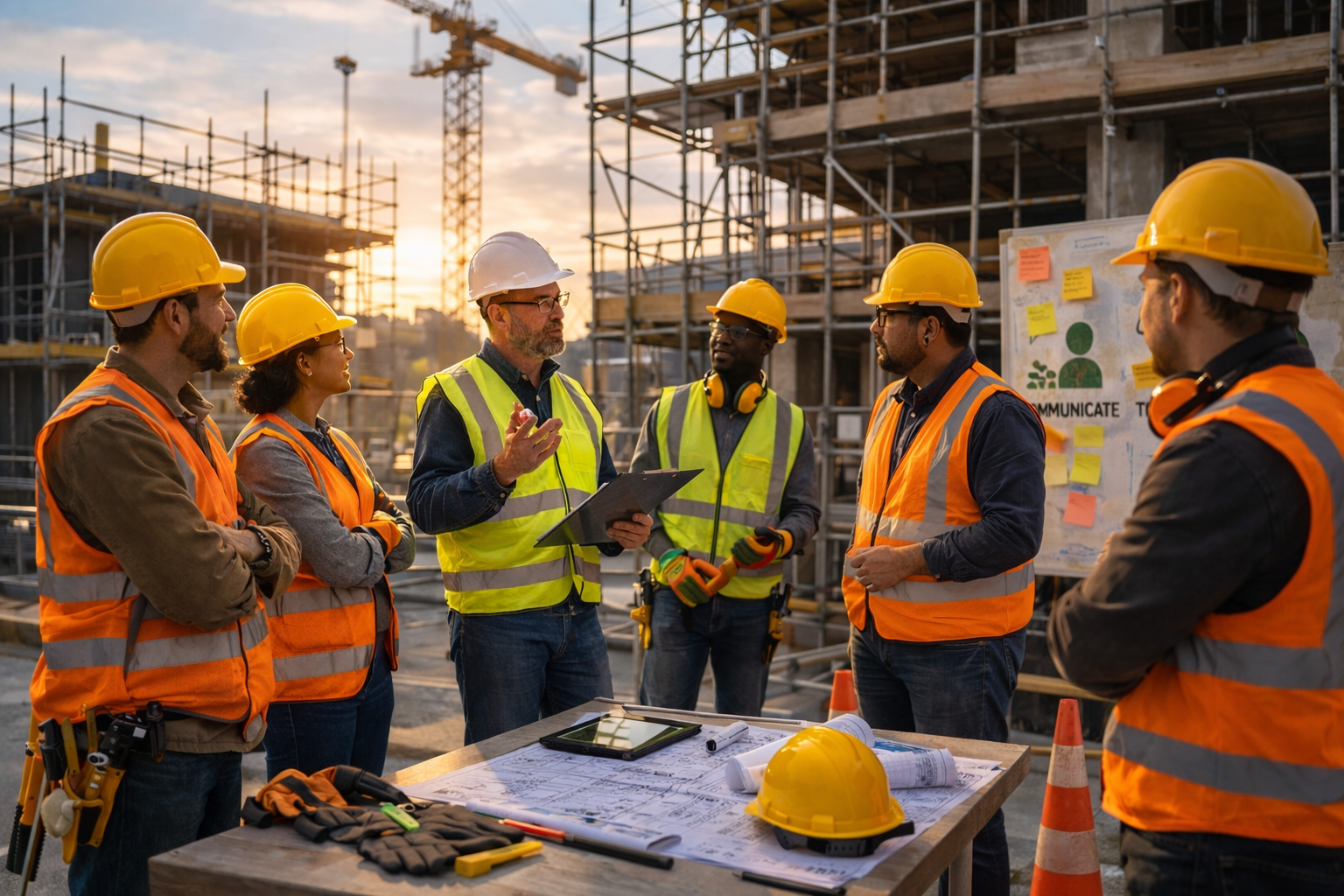
A safety culture is the shared approach to risk, reflected in how people think, communicate, and act, particularly when unsupervised. It is shaped by values, attitudes, competence, and daily behaviours, which determine the seriousness and consistency of health and safety management.
A useful way to view safety culture is through three lenses:
- Behavioural: what people do (e.g., following safe systems of work, challenging unsafe acts)
- Situational: what the organisation has (e.g., resources, procedures, supervision, site conditions)
- Psychological: how people feel (e.g., trust, confidence to speak up, perceived pressure to cut corners)
Safety culture also sits on a spectrum:
- Compliance-focused culture meets minimum rules.
- Continual improvement culture actively anticipates risks, learns, adapts, and keeps improving even when performance looks “fine.”
Why construction needs a stronger safety culture than most industries
Construction sites change daily as new trades arrive, work areas shift, and vehicles and lifting operations move continuously. Multiple contractors often work alongside each other, leaving little margin for error and increasing the potential for severe consequences.
In Great Britain, construction has a high fatal injury rate; one recent figure cited is 51 worker deaths in 2023–2024, with common causes including falls from height and being struck by vehicles or falling objects.
In addition to inherent hazards, cultural pressures can subtly increase risk:
- tight deadlines and productivity targets
- transient workforces and subcontracting
- “We’ve always done it this way” routines
- reluctance to stop work or raise concerns
Leadership sets the tone (and the speed) of culture change
Safety culture is established from the top down, but it is only effective when demonstrated daily on site. Leaders shape priorities in planning, resourcing, and decision-making, and employees follow their actions rather than written messages.
High-impact leadership behaviours include:
- Leading by example (PPE, attending briefings, asking about safety performance routinely)
- Making safety a core value alongside programme and cost—not an afterthought
- Resourcing safety properly (competent supervision, maintenance, training time, quality PPE and equipment)
- Creating conditions where people can speak up and admit mistakes without fear
Culture change takes time, but consistent actions by all, especially leaders, have a cumulative impact.
Build safety into the project lifecycle, not just the workface
A strong safety culture begins before work starts. Early decisions regarding design, procurement, sequencing, and programme pressures influence safety outcomes. Addressing risk throughout the project reduces later trade-offs that may increase hazards for the site team.
Key practices that make safety part of how work is delivered:
- Clear risk assessments and method statements (RAMS) that are task-specific, briefed properly, and used in real time (not filed away)
- Strong site inductions for every worker and subcontractor, covering hazards, emergency arrangements, and rules that matter on this job
- Planning controls into the sequence (access/egress, exclusion zones, lifting plans, temporary works, traffic management, work-at-height strategy)
- Designing out risk where possible and coordinating interfaces between trades so safety isn’t “owned by everyone and no one”
Engagement and empowerment: make safety everyone’s responsibility
A safety culture endures when workers feel respected, heard, and empowered to influence work practices. Engagement must extend beyond signage and routine toolbox talks by establishing channels for genuine input and acting on feedback.
Practical ways to embed empowerment:
- Two-way communication: supervisors ask, listen, and follow up; workers raise issues knowing something will be done
- Worker involvement in risk assessment: people doing the work help shape controls; this improves quality and ownership
- Stop-work authority: explicit permission to pause when conditions are unsafe, without retaliation
- Peer-to-peer accountability: normalise polite challenge and “see something, say something” behaviours
- Safety reps/committees: include different trades and levels so decisions reflect site reality
Competence and training: keep skills current in a changing environment
Construction risks evolve with the programme, work area, and workforce. Training should be ongoing, including induction, task-specific competence, refreshers, and updates when methods or equipment change.
A training approach that supports culture includes:
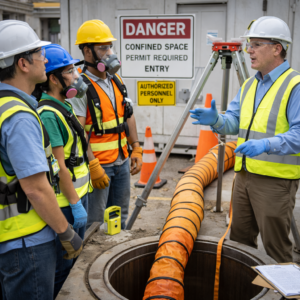
- Role-specific competence (e.g., plant operators, work-at-height tasks, confined spaces)
- Supervisor capability (leading briefings, spotting drift, coaching safe behaviours)
- Short, frequent learning (toolbox talks and targeted refreshers that match today’s risk)
- Explaining “why” behind controls so people understand consequences and don’t treat safety as paperwork
Reporting, “just culture,” and learning: turn near misses into prevention
A learning culture relies on open reporting. When individuals report near misses, hazards, and mistakes without fear of blame, the organisation can learn and prevent recurrence.
To build this:
- Make reporting easy (simple tools and quick routes to raise concerns)
- Respond visibly (fix issues, explain decisions, close the loop so workers see outcomes)
- Investigate impartially to understand what happened and why—focus on prevention, not punishment
- Share learning across sites and teams (what changed, what to watch for next time)
Regular stand-down moments, where work pauses to reflect on lessons from serious incidents and near misses, can refocus attention, reinforce shared responsibility, and encourage speaking up.
Daily routines that make safety culture visible
Culture becomes real through repeatable site behaviours:
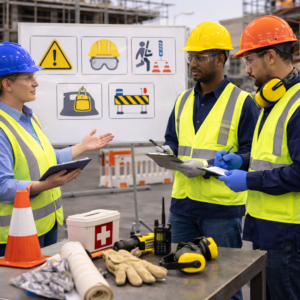
- Pre-start briefings and toolbox talks tied to the day’s critical risks
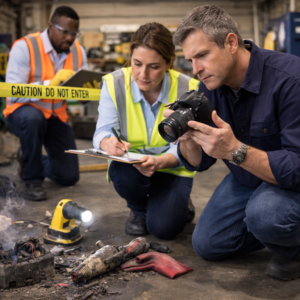
- Safety walkarounds and site checks with feedback loops (what was found, what changed)
- Consistent PPE standards matched to hazards (and enforced fairly)
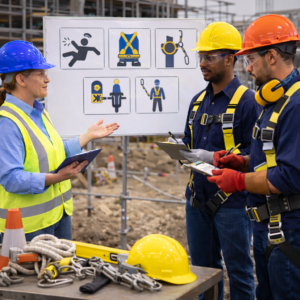
- Work-at-height controls: guardrails, harnesses, nets, compliant scaffolds, and disciplined exclusion zones
- Housekeeping and tool control: secure and store equipment; reduce falling-object and trip hazards
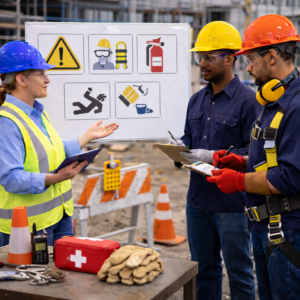
- Emergency readiness: practised procedures, first aid arrangements, clear evacuation routes
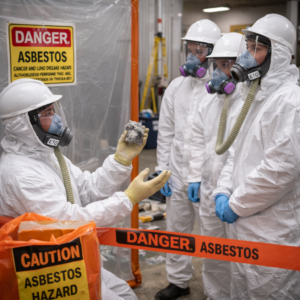
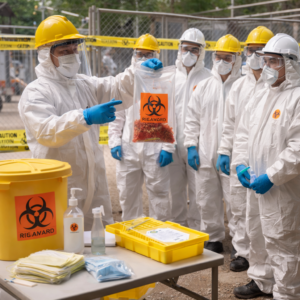
- Hazardous materials discipline: correct storage, labelling, handling training, and ventilation where needed
Measure what matters, then improve continuously
Relying solely on accident counts provides delayed insights. Strong cultures monitor leading indicators, such as near-miss reporting, audit and training completion, and inspection quality, to assess control effectiveness and emerging risks.
A continuous improvement rhythm looks like:
- clear safety goals and expectations
- routine monitoring and review
- audits/inspections that are constructive, not punitive
- regular reflection on what changed and what still drifts
- sharing learning across the supply chain and future projects
Managing subcontractors and interfaces without diluting standards
Construction culture can become fragmented when contractor expectations differ. Maintain consistency by:
- giving every subcontractor the same quality induction and briefing
- Aligning RAMS, permits, and interface controls across trades
- setting clear minimum standards for supervision, PPE, and reporting
- making it safe and acceptable for any worker—regardless of employer—to stop work when it’s unsafe
Mental health, fatigue, and human factors: safety includes well-being
Attention, judgment, and reaction time are critical for safety. Long hours, fatigue, stress, and mental health challenges increase the likelihood of errors. Wellbeing support is therefore an essential safety control, not an optional benefit.
Site-level actions that help:
- planned breaks and realistic pacing
- monitoring fatigue and workload hotspots
- a culture where asking for help is normal
- respectful supervision that checks in, not just checks compliance
Putting it into action: a simple culture-building rollout
Begin by assessing the current situation: observe actual behaviours, identify areas where individuals feel pressured, and determine where risk may be normalized.
Then build momentum through:
- visible leadership routines (walks, briefings, resourcing decisions)
- a no-retaliation reporting approach with fast feedback loops
- competency and supervision upgrades where risk is highest
- a steady cycle of monitoring, learning, and improvement
A strong safety culture is not achieved through a single initiative. It results from thousands of consistent decisions that make safe practices the standard approach to work.