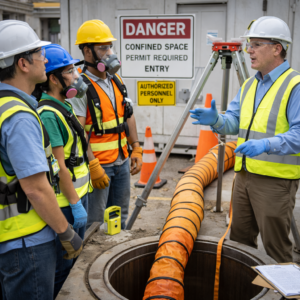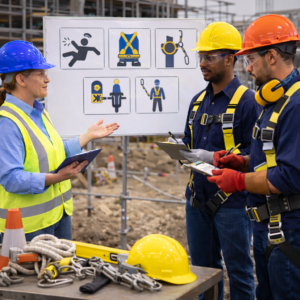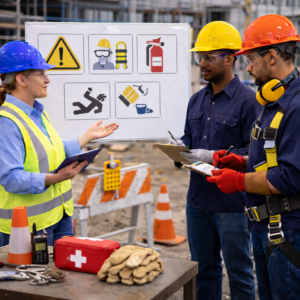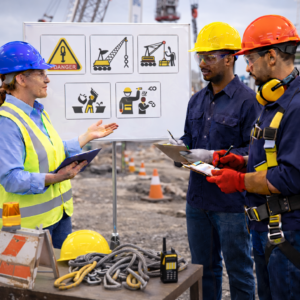

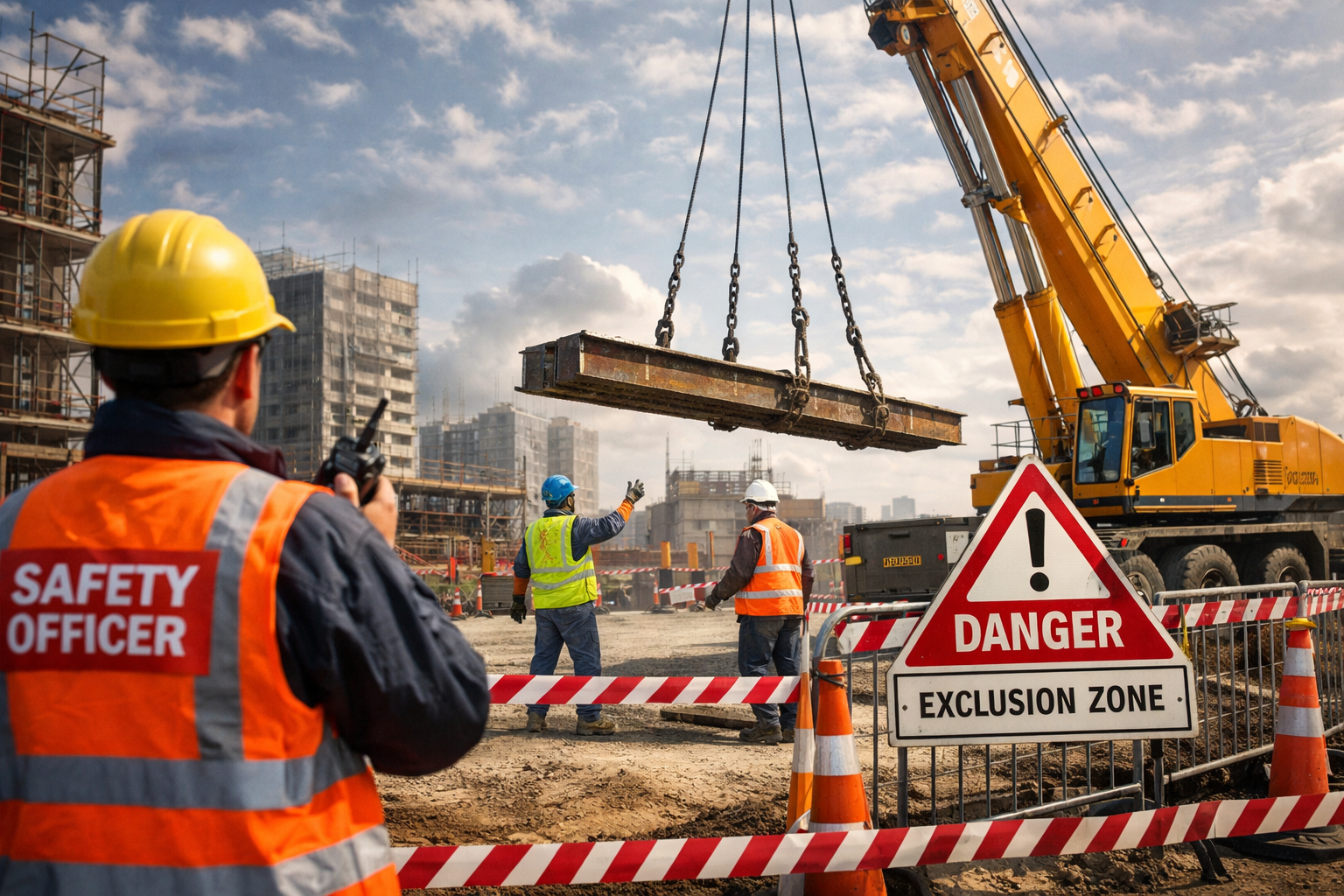
Lifting operations are high-risk because even routine lifts can quickly become hazardous if the load swings, snags, drifts, drops, or passes near people. Safe lifting requires comprehensive planning to keep people safe, clarify responsibilities, and maintain control of the lifting area throughout the operation. HSE states that lifting work must be properly resourced, planned, and organised by competent individuals, with planning proportional to the task’s complexity and risk.
A strong lifting system is built on three things working together: a realistic lift plan, clearly defined roles, and exclusion zones that are designed for real site conditions rather than ideal ones. When any of these are weak, people can end up sharing space with a suspended or moving load, which is exactly what safe systems of work are meant to prevent. In Great Britain, “struck by a moving object” remained one of the leading causes of fatal workplace accidents in 2024/25, with 18 worker deaths recorded by HSE.
Why lifting operations fail
Lifting incidents rarely result from a single error. They typically occur when multiple predictable weaknesses align, such as poor visibility, rushed sequencing, mixed site traffic, unclear supervision, inadequate barriers, changing weather, or people taking shortcuts through lifting areas. Under production pressure, exclusion zones are often crossed if they disrupt pedestrian routes, deliveries, or nearby trades, especially when boundaries are marked only with cones or tape and lack clear control.
Overreliance on alertness is another common issue. Human attention declines over time, and lifting equipment often has blind spots. Systems that depend on someone noticing a breach are less effective than those that physically prevent entry into danger zones. Safe lifting is most effective when exposure is eliminated through design, not just managed by reminders to “be careful.”
Planning the lift properly
Effective lift planning begins before attaching the hook. HSE requires that plans address foreseeable risks, identify necessary resources, and define actions and responsibilities at each stage. For simple, routine lifts in stable conditions, a generic plan may suffice. Complex or higher-risk lifts require a written plan developed by someone with appropriate training, knowledge, skill, and experience.
The most effective plans consider more than just the intended route. They account for the full load envelope, including areas the load could occupy if it swings, rotates, snags, slips, or is unintentionally released. This includes the path beneath the load, the plant’s slewing or tail-swing area, the landing zone, and any overshoot during set-down. If the lift crosses a walkway, roadway, workface, or welfare route, this should be addressed as a design issue before the lift begins, not simply noted in a briefing.
A thorough lift plan must address real site conditions often missed on paper, such as wind, restricted access, proximity to structures, overhead power lines, underground services, uneven ground, deck or slab capacity, nearby deliveries, shared radios, poor visibility, and competing trades. If the plan cannot ensure safe control of the area, the sequence should be changed, other work moved, or the lift delayed until conditions are suitable.
Competence and supervision
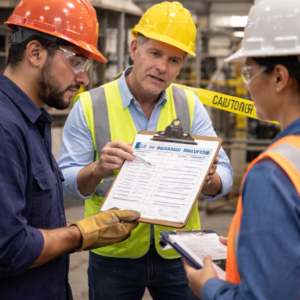
Planning alone is insufficient. HSE requires competent personnel at every stage and supervision proportional to the risk. Routine lifts may need minimal supervision, but unusual loads, challenging environments, public interfaces, blind lifts, or congested sites require closer oversight.
Competence in lifting operations encompasses both practical and technical skills. People involved need to understand the equipment, the load, the environment, the method, and the applicable legal duties. They also need enough authority to act when conditions change. A safe system breaks down quickly when a person knows there is a problem but feels unable to stop the job.
Roles that must be clear before the lift starts
Clear roles are essential for every lifting operation. The planner designs the safe method, the supervisor ensures the method is followed, the operator controls the equipment, and the slinger/signaller or banksman manages load attachment, signalling, and movement. On busy sites, a specific individual should be named to manage the exclusion boundary to ensure this responsibility is not overlooked or informally assigned.
This matters because many failures happen at the interfaces. The operator may not be able to see the landing area. The slinger may be focused on rigging. The supervisor may be covering several tasks. Other contractors may assume someone else is keeping their people away. If nobody can clearly answer “Who owns this zone?” or “Who can stop the lift?”, then the operation is already exposed. Ownership needs to be assigned by name, communicated to everyone affected, and confirmed again whenever the lift plan or site conditions change.
Exclusion zones and why they matter
An exclusion zone is the controlled area where people who are not directly involved in the lift must not enter. Its purpose is simple: if the load moves unexpectedly, falls, swings, or the equipment moves into a danger area, there should be nobody there to be struck. HSE says loads should not be suspended over occupied areas where this can be avoided, and where suspension cannot be avoided, the risks must be minimised. If loads are suspended for significant periods, the area below should be treated as a danger zone with restricted access.
An effective exclusion zone extends beyond the area directly under the hook. It must address hazards in three dimensions: under the load path, around the crane or lifting plant, the set-down area, and any area affected by swing, drift, snagging, release, or tail-swing. If people can easily cross the boundary or if it intersects normal access routes, the zone is likely to fail under pressure.
Setting up an exclusion zone that works
Before lifting begins, the team should assess the equipment, load, environment, and expected load movement, then clearly mark the exclusion zone with controls appropriate to the risk. In lower-risk situations, signs and temporary barriers may suffice, but in high-traffic or higher-risk areas, robust physical barriers are more effective than cones or tape. Defined entry points, gate lock-offs, diversion routes, and active marshalling help enforce the boundary.
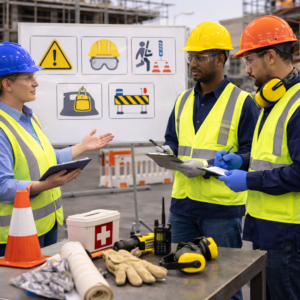
A pre-lift briefing or toolbox talk is essential to ensure everyone understands the lift sequence, danger areas, access restrictions, signals, stop rules, and procedures for changes. This briefing should include not only the lifting team but also nearby trades, drivers, visitors, and anyone affected. A boundary understood only by the lifting crew is not fully controlled.
Safe zones must be maintained throughout the entire operation, including rigging, lifting, traveling, landing, and de-rigging. A common error is relaxing control as the load nears the ground, even though set-down can be unstable due to rotation, trapped slings, pinch points, and last-minute adjustments. The area should remain controlled until the load is stable, safely detached, and equipment is clear.
Communication during the lift
Clear communication is critical, especially during blind lifts, lifts near public or shared areas, and multi-team operations. Signals must be agreed upon in advance and understood by all involved. If radios are used, the channel should be clear and dedicated to the lift to prevent critical instructions from being lost. If communication breaks down, the operation must stop until control is restored.
Stop-work authority must be genuine, not just documented. The person managing signals or the exclusion zone must be able to halt the lift immediately if visibility is lost, a barrier is breached, wind increases, the load behaves unexpectedly, or the route becomes unclear. Supervisors and management must visibly support this authority, as it is often most needed under pressure.
Common weaknesses that create danger
Unsafe lifting operations often share common weaknesses: planning only the intended route instead of the full movement envelope, marking zones on paper rather than on site, relying solely on verbal warnings, allowing non-essential personnel to remain nearby, assigning boundary enforcement to multitasking staff, and reducing zone size to maintain production instead of adjusting the sequence. Wind, poor visibility, shared workspaces, and poorly placed materials can exacerbate these issues.
On busy sites, exclusion zones are often treated as flexible. If a zone conflicts with normal movement, people tend to take the easiest route unless the area is redesigned, diverted, and actively controlled. The safest operations make safe behavior easy and unsafe behavior difficult.
Practical controls that improve lifting safety
Safer lifting operations use a combination of controls rather than relying on a single measure. These include a proportionate lift plan, competent personnel, equipment checks, a clear load path, a named exclusion-zone owner, physical barriers, defined access routes, visible signage, dedicated signalling, effective supervision, and a hard stop rule for any breach or change in conditions.
It is best practice to integrate the lifting zone into the overall site programme rather than treating it as a temporary inconvenience. Scheduling the lift as a hold point with designated no-go times, alternative pedestrian routes, delivery restrictions, and temporary work stoppages in adjacent areas can be arranged in advance. This approach reduces conflict, minimizes delays, and makes compliance more achievable under pressure.
Final thoughts
Safe lifting operations depend on removing exposure. Safe lifting operations require eliminating exposure before the lift begins and maintaining control throughout the lift. The lift plan must address actual risks, not idealised conditions. Roles should be specific, named, and supported by authority. Exclusion zones must reflect real movement patterns of loads and people, not just lines on a drawing. When planning, supervision, and boundary control are aligned, the risk of people being struck by loads is significantly reduced.