Laboratory Safety Management Essentials
Build safer laboratories with stronger management, clearer control, and more confident decision-making.
Laboratory risks can escalate quickly when safety systems are inconsistent, outdated, or poorly managed. This course provides a practical foundation in laboratory safety management so learners can better support hazard control, safer work practices, stronger compliance awareness, and a more resilient safety culture.
Why this course matters
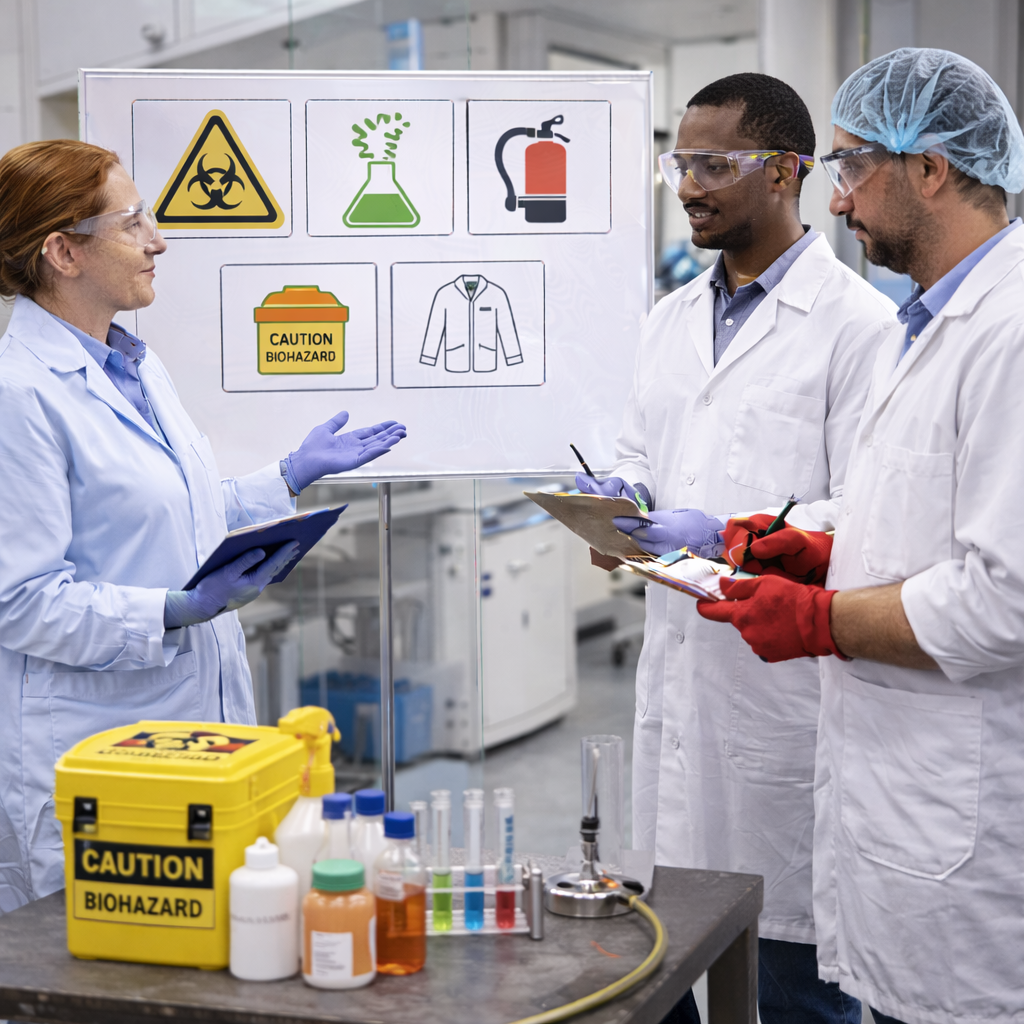
Laboratories operate in environments where chemical, biological, physical, and procedural hazards can intersect. Without a strong management approach, even routine work can introduce unnecessary risk through weak controls, inconsistent procedures, poor communication, inadequate training, or gaps in emergency preparedness.
Laboratory Safety Management Essentials is designed to help bridge the gap between technical work and effective safety oversight. It introduces the core concepts needed to support safer laboratory operations, improve consistency, and strengthen the systems that protect people, research quality, and organizational performance.
🧪
Recognize laboratory risks
Build stronger awareness of common laboratory hazards and the management systems needed to control them.
🛡️
Strengthen safety oversight
Learn the essentials that help laboratories improve procedures, communication, accountability, and control measures.
📋
Support safer daily operations
Gain practical knowledge that helps translate safety expectations into more consistent laboratory practice.
Course Overview
This course introduces the core principles behind effective laboratory safety management. Learners explore how strong safety oversight supports hazard recognition, risk assessment, safe work practices, personal protective measures, standard operating procedures, incident prevention, emergency readiness, and overall laboratory performance.
Whether you are responsible for supervision, safety coordination, compliance support, or laboratory operations, this training helps connect laboratory safety principles to practical management decisions.
Hazard Recognition
Risk Assessment
Safe Work Practices
PPE & Controls
SOPs & Documentation
Emergency Preparedness
Learning Outcomes
- Explain the purpose and importance of laboratory safety management in protecting people, operations, and organizational performance.
- Recognize common laboratory hazards, including chemical, biological, physical, and procedural risks.
- Understand the role of risk assessment, hazard controls, and safe work practices in laboratory settings.
- Identify how procedures, training, communication, and supervision support safer laboratory operations.
- Strengthen awareness of PPE, engineering controls, housekeeping, labeling, and waste-handling considerations.
- Recognize the importance of incident reporting, emergency preparedness, and continuous improvement in laboratory safety systems.
- Contribute more confidently to laboratory safety oversight, planning, and day-to-day management discussions.
Who This Is For
- Laboratory managers, supervisors, and team leaders responsible for safe laboratory operations.
- Health and safety professionals supporting laboratory environments or research facilities.
- EHS coordinators, compliance personnel, and occupational health staff involved in laboratory oversight.
- Researchers, technicians, and laboratory personnel seeking a stronger foundation in laboratory safety management.
- Organizations aiming to improve consistency, accountability, and safety culture across laboratory settings.
- Anyone who needs a practical introduction to laboratory safety management essentials.
What makes this training valuable
Practical foundation
Focuses on the core systems and behaviors that support safer laboratory operations in the real world.
Operational relevance
Helps connect safety principles to everyday laboratory management, communication, and oversight.
Stronger decision-making
Builds confidence to support better planning, hazard control, and continuous improvement.
Take a more proactive approach to laboratory safety
Effective laboratory safety management is not just about avoiding incidents. It is about creating the structure, clarity, and consistency needed for safer people, stronger operations, and better outcomes.
Build the knowledge needed to support smarter laboratory safety decisions, stronger oversight, and a more confident safety culture.
Related topics: personal protective equipment, PPE selection, PPE use, PPE maintenance, hazard assessment, eye protection, hand protection, respiratory protection, hearing protection, protective clothing, workplace safety, compliance training