Industrial Electrical Controls Fundamentals
Build safer troubleshooting habits, reduce downtime, and improve confidence around industrial control systems
Modern machines depend on electrical controls, but when those systems are misunderstood, small issues can quickly become safety incidents, misdiagnosed faults, or costly interruptions. This course gives learners a practical foundation in industrial electrical controls so they can work more safely, think more clearly, and respond with greater confidence.
Why this course matters
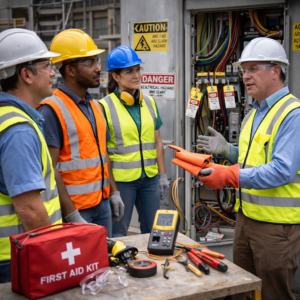
Unexpected start-up, improper interlocks, miswired control circuits, and unsafe troubleshooting can create serious risk for both people and production. In many workplaces, the challenge is not just the fault itself, but the lack of a clear, practical understanding of how control systems behave under normal and abnormal conditions.
This course helps close that gap. It takes learners from awareness to action with plain-language guidance, real-world context, and a stronger decision-making framework for working around electrical control panels, machinery, and control-system hazards.
⚙️
Understand Core Components
Gain clarity on relays, contactors, sensors, starters, and VFD basics.
🛡️
Improve Safety Awareness
Recognise hazards linked to control panels, machinery, interlocks, and emergency stops.
🔎
Troubleshoot More Safely
Build better habits around verification, fault awareness, and knowing when to escalate.
📋
Support Reliable Maintenance
Understand how documentation and labeling strengthen safe maintenance and change control.
Course Overview
Industrial Electrical Controls Fundamentals is designed for professionals who need a practical understanding of how industrial control systems work and how failures within those systems can create operational and safety consequences.
The course introduces the core building blocks of industrial electrical controls, including the components and basic circuits commonly found in machine-control environments. It explains how these elements interact with guarding, interlocks, and emergency stops, while also building awareness of the failure modes that can lead to unsafe conditions or unnecessary downtime.
Rather than focusing only on theory, this training is structured to help learners think more practically in the field. It reinforces safer troubleshooting habits, stronger verification steps, and better judgment around when qualified personnel should take over, giving teams a clearer, more consistent approach to electrical control-system risk.
Learning Outcomes
✓ Understand the core components used in industrial control systems
✓ Recognise how basic control circuits function within machinery and equipment
✓ Identify hazards linked to control panels, unexpected start-up, and unsafe troubleshooting
✓ Understand the role of guarding, interlocks, and emergency stops in control-system safety
✓ Develop safer troubleshooting and verification habits before taking action
✓ Recognise common failure modes and know when to involve qualified personnel
✓ Appreciate how documentation and labeling support safe maintenance and change control
✓ Build a practical mental model that supports safer, more consistent field decisions
Who This Is For
This course is especially suitable for:
Maintenance technicians
Electricians
Automation support staff
Supervisors
Engineers
Operations teams working around machinery
It is ideal for organisations that want a shared vocabulary across maintenance, engineering, and supervisory teams so handoffs improve, troubleshooting becomes safer, and workers are better able to recognise when to stop work and escalate.
Turn control-system knowledge into safer, repeatable performance
When teams understand how industrial electrical controls behave, they make better decisions under pressure, diagnose faults more effectively, and reduce the chance of unsafe intervention.
Strengthen awareness, improve troubleshooting discipline, and help your workforce protect both people and production with a more confident approach to industrial electrical controls.
Related topics: industrial electrical controls, control circuits, motor controls, control panels, electrical schematics, sensors and actuators, machine automation, troubleshooting, equipment maintenance, lockout tagout, electrical safety, industrial safety